 Oklahoma Senate
Sen. Rice Will Re-Introduce "Steffanie's Law"
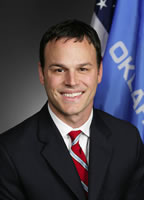 Sen. Andrew RIce
State Senator Andrew Rice (D-OKC) announced today that he and other members of the Senate Democratic caucus, in their continued effort to hold insurance companies accountable, will re-introduce "Steffanie's Law," in hopes the Republican controlled Legislature will give the idea a second look in a non-election year.
Steffanie's Law, if passed by the legislature and signed by the governor would require health insurance providers in the State of Oklahoma to cover routine care costs for patients participating in a clinical trial. The same legislation was refused a hearing in the Republican controlled House of Representatives last session.
"Families in Oklahoma should not have to decide between potential life-saving treatments and personal financial ruin," Rice said. "With our worsening economy here in Oklahoma, it is more important now than ever that we enact laws that will ensure economic fairness for our families."
Rice said "Steffanie's Law," or Senate Bill 263, is the same as last year's bill, and would relieve Oklahoma families of the risk of losing their health insurance coverage by participating in clinical trials. He said often times, clinical trials are the best available treatment for these family's illnesses. Currently, some insurance companies deny coverage of routine health care costs once a patient joins a clinical trial.
"I am confident we can get this bill to the Governor's desk," Rice said. "We had 31 bi-partisan votes in the Senate last year only to see the bill die because a Republican House committee chairman who works for the Insurance industry refused to hear it."
Rice said almost half the states in the country have passed legislation or instituted special agreements requiring health plans to pay the cost of routine medical care that patients receive as a participant in a clinical trial and he believes Oklahoma should follow their lead. He explained routine patient care costs are the usual costs of medical care, such as doctor visits, hospital stays, clinical laboratory tests, x-rays, etc.,
that you would receive whether or not you were participating in a clinical trial.
Nancy Thomason, Founder and President of Oklahoma Brain Tumor Foundation, said the decision of pursuing clinical trial treatment should be made by the physician, the patient and family members, not insurance companies. She said even if you have health insurance, your coverage may not include some or all of the patient care costs associated with a clinical trial because some health plans define clinical trials as "experimental" or "investigational" procedures.
"Oklahoma is blessed with state-of-the-art health care facilities where new clinical trials, most often paid for by sponsoring groups such as the National Cancer Institute, are creating hope for patients with life-threatening diseases," Rice said. "It's not right that the only obstacle to possible life-saving treatment is an insurance company which has ruled that participating in clinical trials disqualifies you from their health care coverage that you pay for every month."
The Oklahoma City Democrat also said research has shown lack of such coverage is a significant barrier to many patients who might otherwise enroll in a trial. Lack of coverage also makes it harder for researchers to successfully conduct trials that could improve prevention and treatment options. The taxpayer supported University of Oklahoma Cancer Center is one such research institution that is negatively impacted by this phenomenon.
Rice said Senate Bill 263 is named in the memory of Steffanie Collings. She was diagnosed with brain cancer at the age of 14. Her insurance carrier refused coverage since she underwent clinical trials to treat her brain tumor. Steffanie died from her illness in March of 2008 as last year's legislation was making its way through the Oklahoma Senate.
Monty Collings, Steffanie's father, said her routine patient care costs reached hundreds of thousands of dollars and that her insurance carrier has denied most of the claims. He said his family has faced considerable financial hardship even though they have health insurance.
"This legislation will not help my family, but it will help others that could end up in our situation," Collings said. "I watched my daughter struggle with her cancer and even though it put my family in financial peril, I would make the same decision again when doctors tell me that clinical trials could be her only chance at survival."
