 Oklahoma Senate
Art Fund president Charles Ford explains the Territorial Governors.
In order to provide equal access and equal opportunity to people with diverse abilities, this site has been designed with accessibility in mind. Click here to view
Share
back to press releases
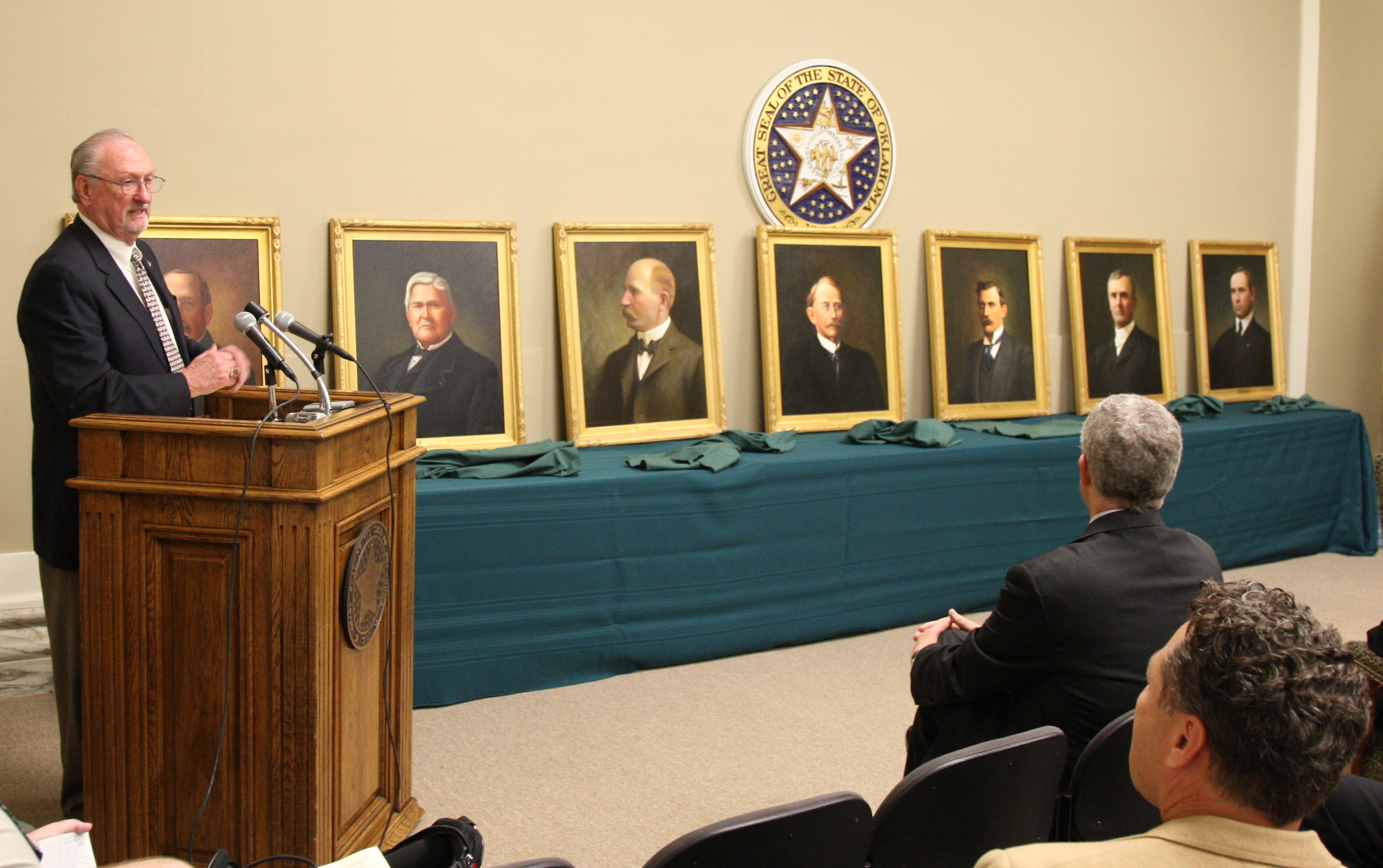 Art Fund President Charles Ford
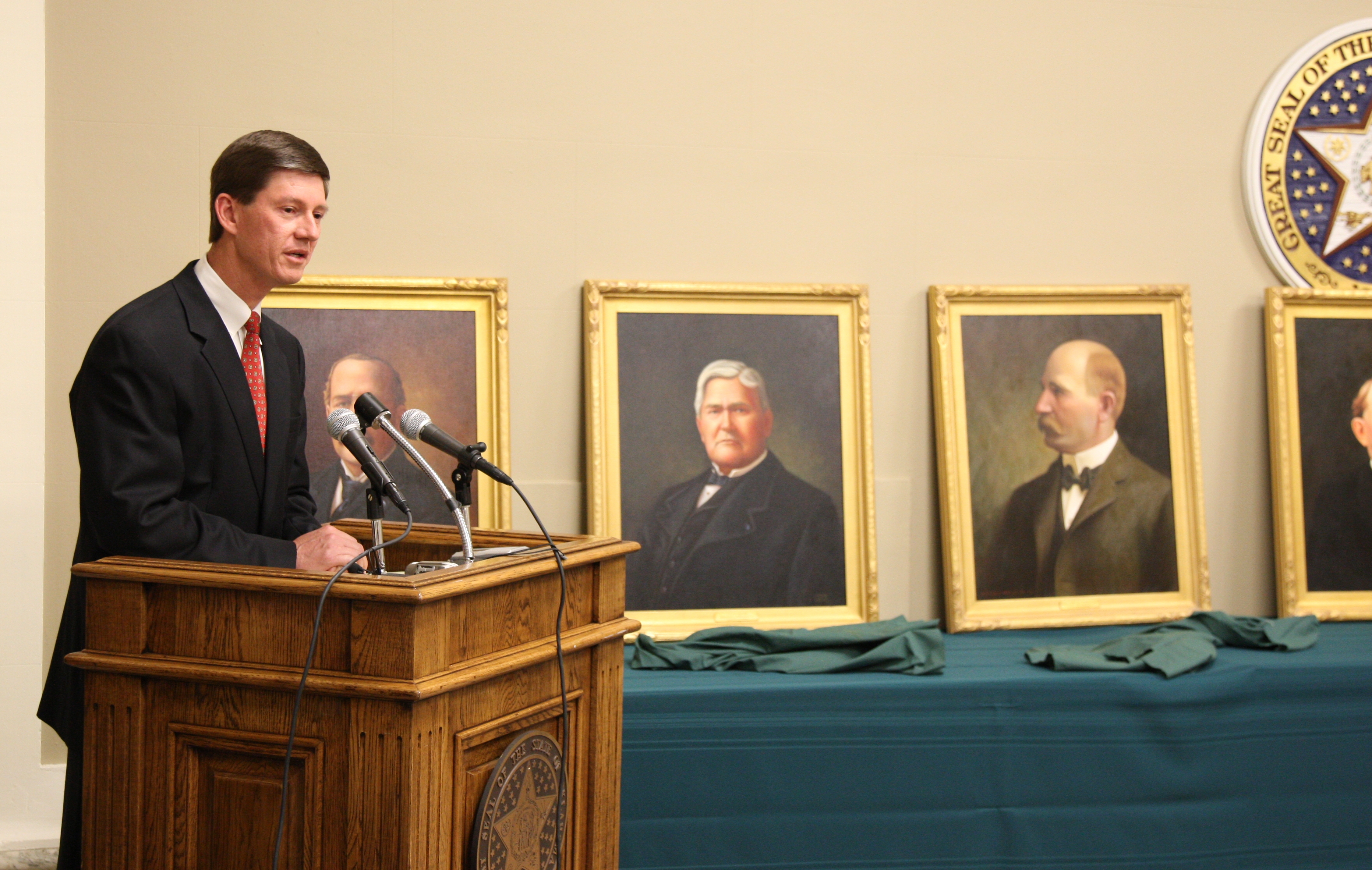 PSO President Solomon Stuart
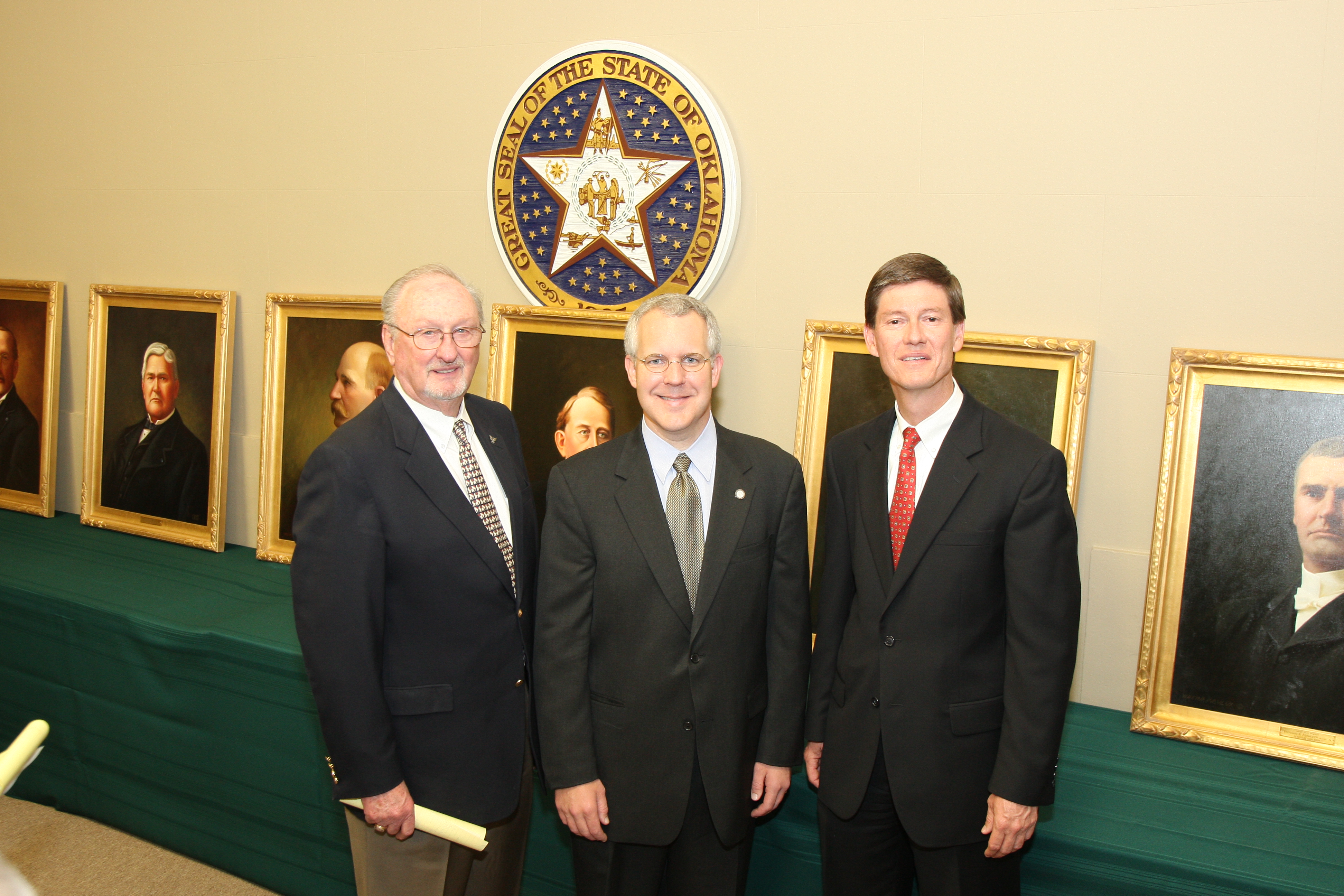 Art Fund President Charles Ford, Governor Brad Henry and PSO President Stuart Solomon
Portraits of Territorial Governors Dedicated
Art Fund President Charles Ford
PSO President Solomon Stuart
Art Fund President Charles Ford, Governor Brad Henry and PSO President Stuart Solomon
PSO president Stuart Solomon on sponsoring the portraits.
Gov. Henry discusses the portraits and how they add to the beauty of Capitol.
Sen. Ford further discusses portraits.
Portraits of Oklahoma’s seven territorial governors were dedicated Monday by officials of the Public Service Company of Oklahoma (PSO) and Governor Brad Henry at the State Capitol.
“This is a great honor for PSO to sponsor these magnificent, beautiful portraits that will be a lasting memorial to these men who helped set in place the legacy that still defines our state today,” said Stuart Solomon, President of PSO. “As Oklahomans most of us can trace our roots to pre-statehood and this is especially true for our company which was established in 1889. Our company has in essence grown up with the state, so being able to be a part of this historic project recognizing these early leaders is very special to us.”
The portraits, by artists Mike Wimmer of Norman, Christopher Nick of Oklahoma City and Timothy Tyler of Siloam Springs, Arkansas, were sponsored by PSO and commissioned by the Oklahoma State Senate Historical Preservation Fund.
“These works are a wonderful addition to the State Capitol art collection. I want to thank Sen. Ford, the sponsors and the artists for their great work,” said Gov. Henry. “These paintings are proof that you can find some of the best art in the world right here in Oklahoma.”
Oklahoma’s Territorial Governor’s were George W. Steele, Abraham J. Seay, William C. Renfrow, Cassius M. Barnes, William M. Jenkins, Thomson B. Ferguson and Frank Frantz.
“These portraits are a tremendous tribute to Oklahoma’s forefathers. As we begin our second century, it’s fitting that we recognize those seven men who helped lead the settlers and mold Indian Territory into what became the great state of Oklahoma,” said Charles Ford, presidents of the Senate art fund. “With his strengths and talents, each of these men helped bring something new to the table that helped further strengthen the territory and it’s important that we remember their contributions to the state.”
Steele, a Republican, served from 1890 to 1891. Born in 1839, he served with the Union Army during the Civil War. Steele was elected to Congress from 1883 to 1889 and his experience there may have led President Harrison to select him as the first Oklahoma Territorial Governor. He took the oath of office in Guthrie on May 22, 1890 and tried to bring order to the chaotic legislature. The school systems, three colleges and the State library were established during his term.
Born in 1832 in Virginia, Seay’s family moved to Osage County, Missouri, in 1835, where he was admitted to the bar in 1861. He served as a Colonel for the Union Army during the Civil War and then returned to Missouri where he practiced law and served as a judge. In the course of that time, he served as an Associate Justice of the Supreme Court of Oklahoma Territory and it was from there that he became governor from 1892 to 1893. Seay passed away in 1915 and was buried in Kingfisher.
In 1893, the one and only Democrat to serve as Governor of the Territory, was appointed to office. Renfrow served from 1893 to 1897. Born in 1845 in North Carolina, he left school at the age of 17 to serve in the Confederate Army until 1864. After the war, he moved to Russellville, Arkansas and was a deputy county official until he moved to Norman, Oklahoma where he entered the banking business. During his term, the Cherokee Outlet opened and the Oklahoma Historical Society was formed. Renfrow died in 1922 and is buried at Russellville.
Barnes was born in 1845 and spent his early life in Michigan. He served in the Union Army during the Civil War. In 1890, he moved to Guthrie to become Receiver of the U.S. Land Office. He served in the third and fourth Territorial Legislatures and became Governor of the Territory in May of 1897, and served until 1901 when he became president of a bank. He later became Mayor of Guthrie. Barnes died in New Mexico in 1925 and is buried in Guthrie.
Jenkins was born in 1856 in Ohio and upon admission to the bar in 1893, moved to Arkansas City, Kansas to practice law. He made the run into the Cherokee Outlet and homesteaded in Kay County. He served as Secretary of the Territory from June 1897 until he became Governor serving from May 12, 1901 to November 30, 1901. He moved to California but returned to live in Sapulpa until his death in 1941.
Born in Iowa in 1857, Ferguson spent his early years in Kansas where he was a teacher and a Methodist preacher. In 1889, he made the land run into Oklahoma and secured a claim near Oklahoma City. He returned to Kansas and became an editor and author, but later returned to Watonga to establish a newspaper. After serving as Governor from 1901 to 1906, he returned to newspaper publishing until his death in 1921.
The last Territorial Governor was Frantz who served from 1906 to 1907. He was born in 1872 and made his home in Medford shortly after the opening of the Cherokee Outlet. He served with the “Rough Riders” under Colonel Theodore Roosevelt. After the Spanish-American War, Frantz moved to Enid where he was named post-master from 1901 to 1903. He also served as Indian Agent of the Osage Agency until becoming Governor in January of 1906. His spent his later life in the oil business. Frantz died in 1941 and is buried in Tulsa.
“We want to thank PSO for helping bring these beautiful portraits to the Capitol,” said Ford. “Just as it’s important for the public to be involved in their government today, it’s also important for each of us to know where we came from and how our state’s story began.”
The portraits will hang in the second floor foyer outside the Governor’s large conference room.
These portraits and other works of art commissioned by the Oklahoma State Senate Historical Preservation Fund, Inc. can be found on the Senate website at www.oksenate.gov.
Contact info
Pam Hodges' Office: (405) 521-5675

