In order to provide equal access and equal opportunity to people with diverse abilities, this site has been designed with accessibility in mind. Click here to view
 Oklahoma Senate
Painting of Robber’s Roost Dedicated
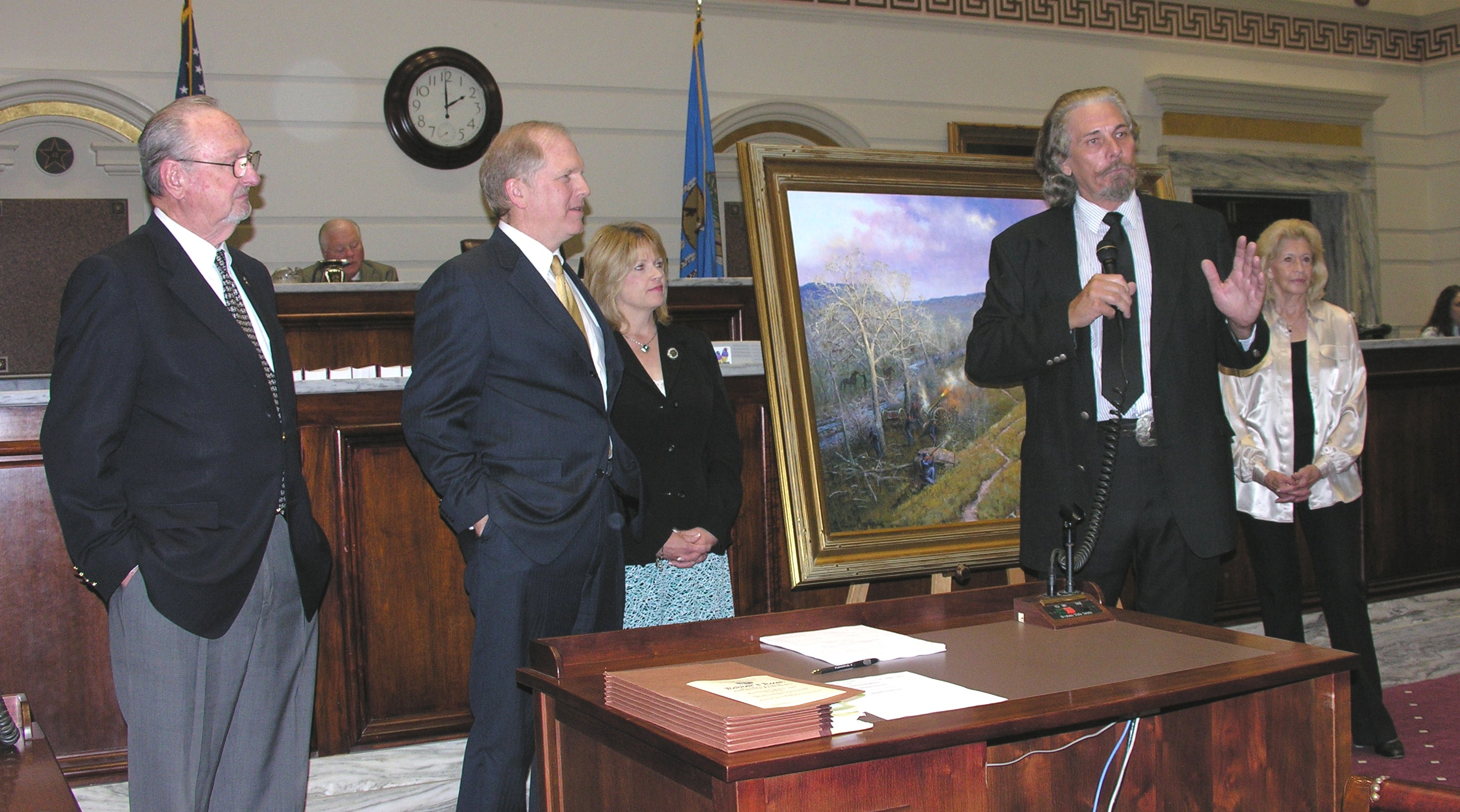
Artist Wayne Cooper explains his painting Wednesday on the Senate floor alongside his wife, Clara, as well as Oklahoma State Senate Historical Preservation Fund president and former senator Charles Ford and sponsors Senator Owen and Charlette Laughlin.
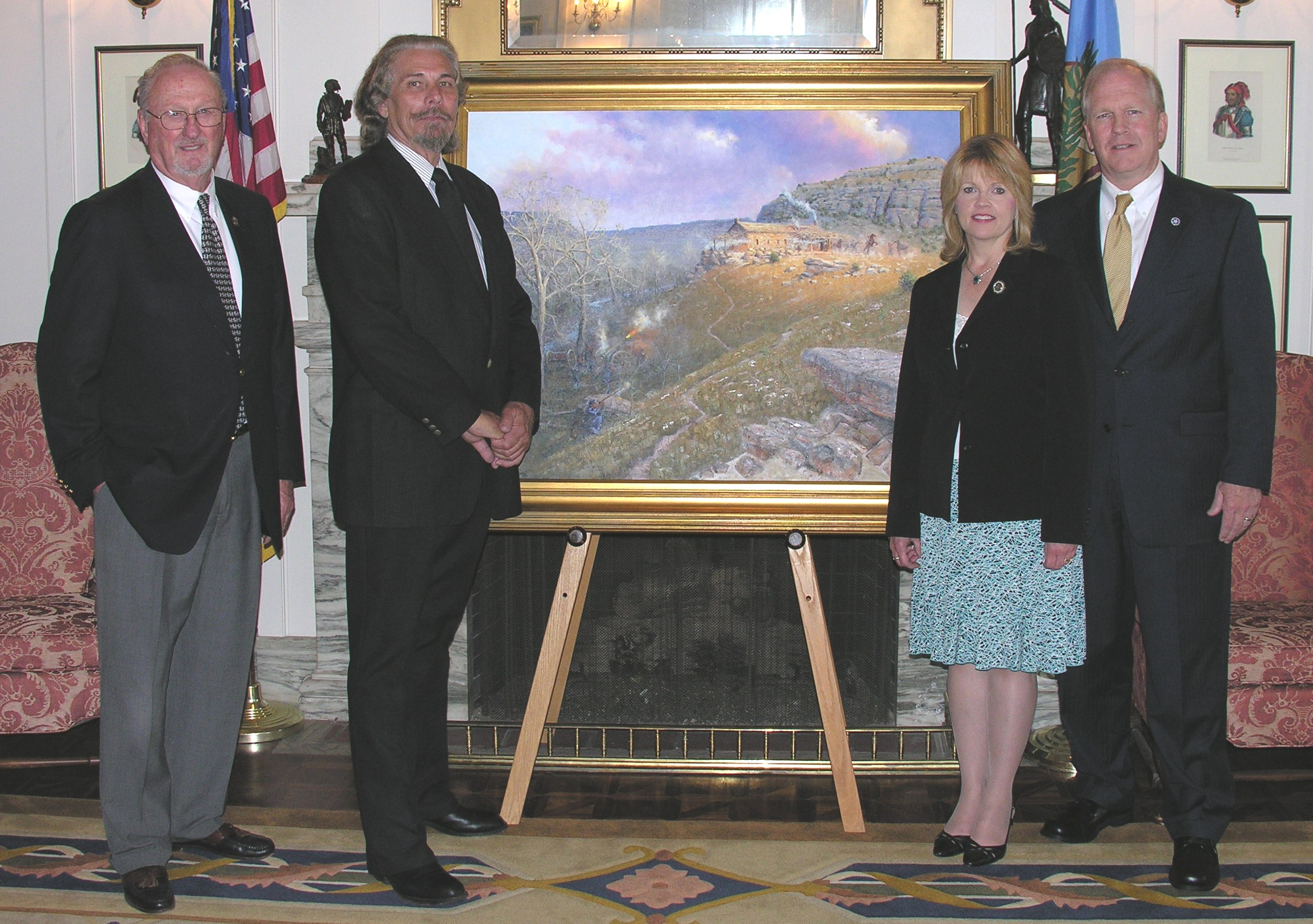
Oklahoma State Senate Historical Preservation Fund president Charles Ford, artist Wayne Cooper and sponsors Senator Owen and Charlette Laughlin pose with Robber’s Roost in the Senate Lounge Wednesday.
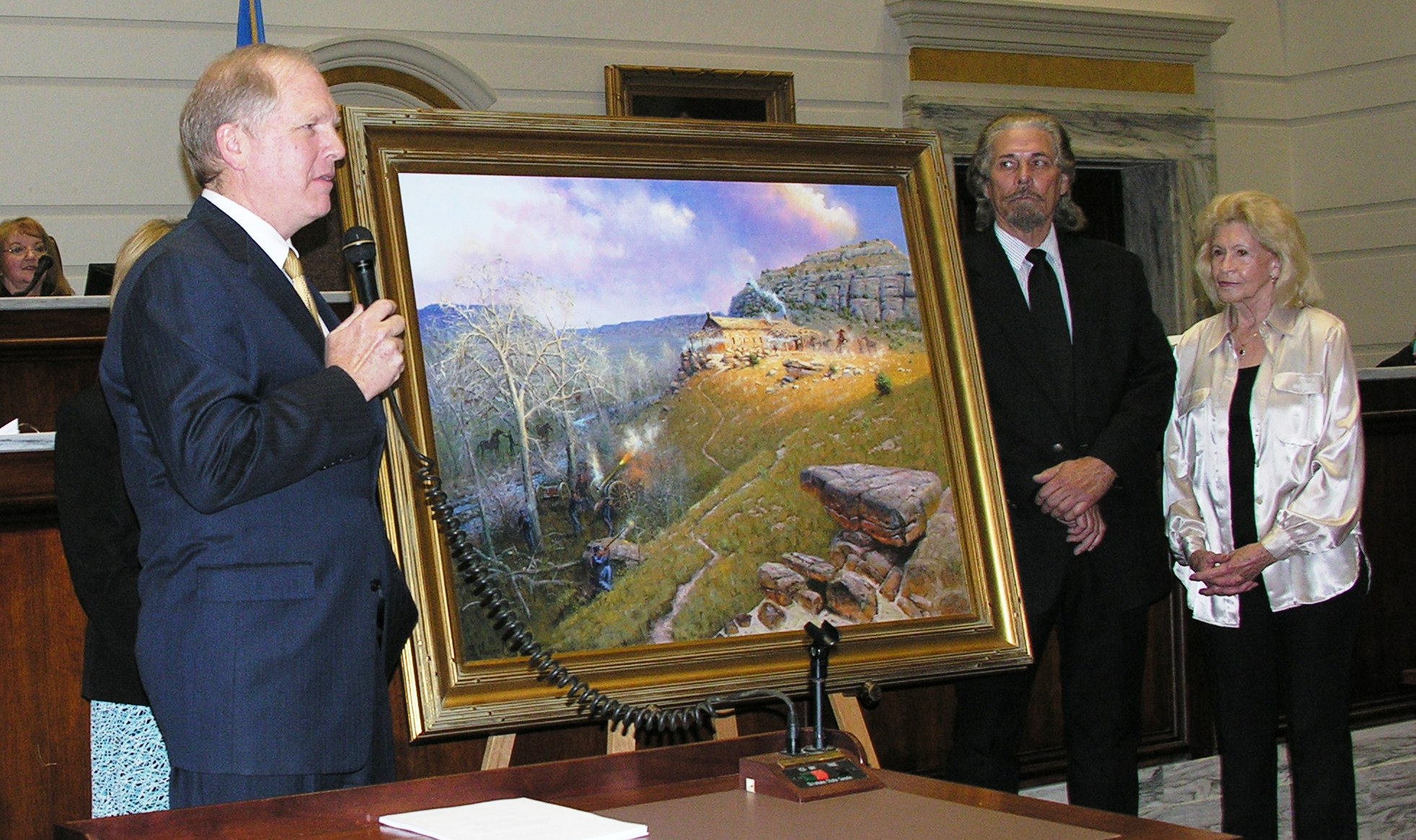
Senator Owen Laughlin, the sponsor of Robber's Roost, discusses the history of the outlaw fortress and No Man's Land in the Panhandle.
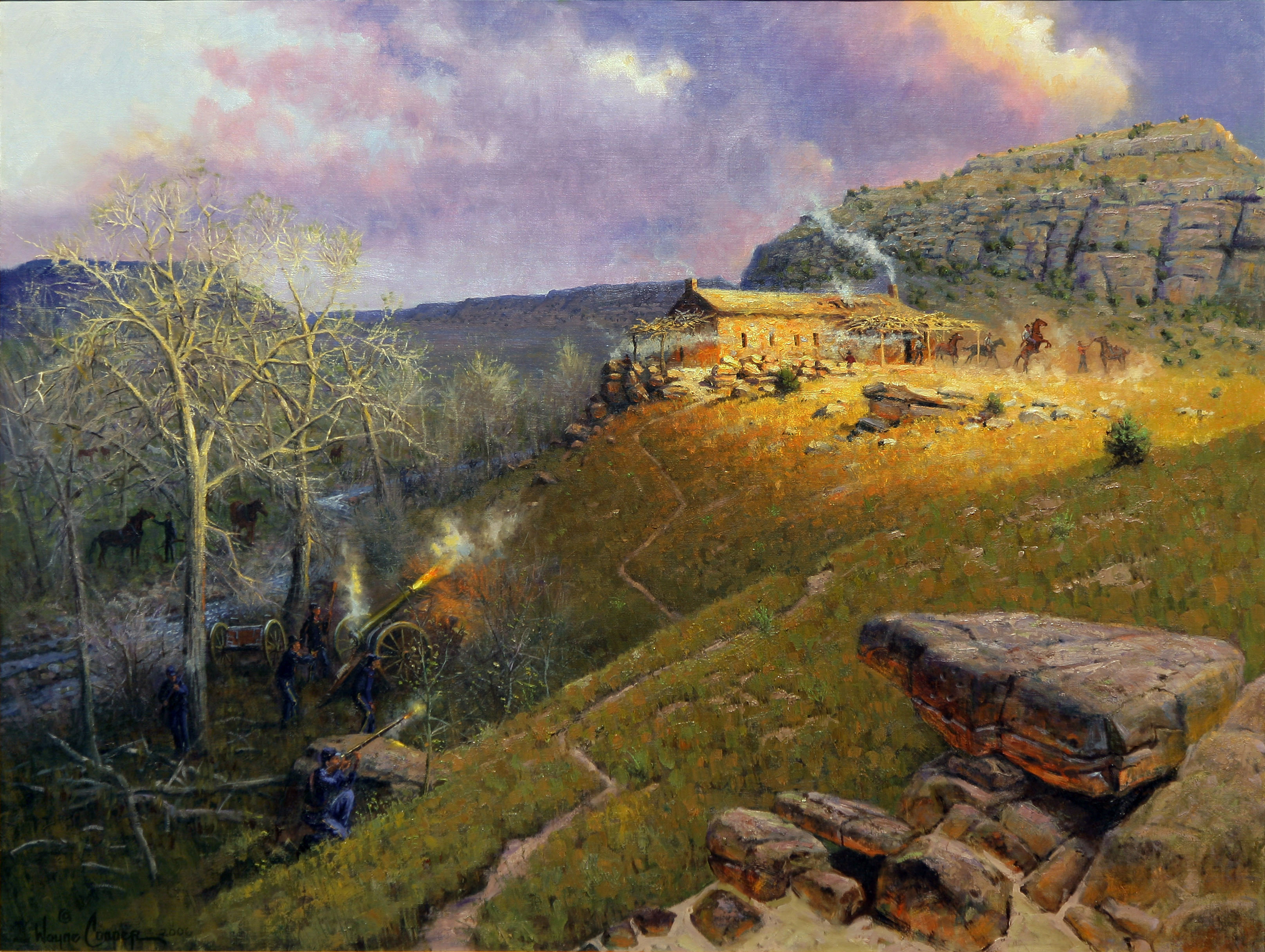
Painting of Robber’s Roost Dedicated
A painting of one of the Oklahoma Panhandle’s historic sites was dedicated at the Oklahoma State Capitol Tuesday. The painting of “Robber’s Roost” by artist Wayne Cooper was commissioned by the Oklahoma State Senate Historical Preservation Fund and sponsored by Senator Owen and Charlette Laughlin.
The painting's sponsor, Senator Owen Laughlin, has represented Northwest Oklahoma and the panhandle area since 1996. "My family and I were so honored to sponsor this beautiful painting," said Laughlin. "Robber’s Roost is just one of the many rich tales in the fabric of Oklahoma’s 100-year history. Unfortunately, many are unfamiliar with it and only the foundation of this once magnificent fortress is standing today. But by having this painting in the Capitol, the story of Robber’s Roost will never die.”
Besides serving as a senator, Laughlin is also a Certified Flight Instructor and attorney. He has also been in the banking business and managed real estate investments since his graduation from Southern Nazarene University in 1973 with a BA Degree in Political Science.
Robber's Roost was a rock fortress with stone walls 30 inches thick that was built by a band of outlaws led by Captain William Coe in No Man's Land in the late 1860's. It had one door and instead of windows had 27 tall, narrow portholes. This region near the Black Mesa was left unclaimed in 1850 when Congress established the boundaries for Texas, Kansas and New Mexico. Therefore, Congress declared it "neutral" or "No Man's Land" and soon forgot about it. The result was a region without any kind of government or law where outlaws and thieves began congregating because of the security the area offered them.
Coe had around 50 followers that were known for stealing livestock from the Army and settlers in the area. Because of the nature of the structure known as Robber's Roost, the Army brought in a cannon to fire on the fortress to rid the area of the outlaws.
The Preservation Fund was created and is overseen by former State Senator Charles Ford of Tulsa.
"This painting truly represents the history of Oklahoma’s Panhandle,” said Ford, President of the Preservation Fund. “The story of Robber’s Roost is a classic Wild West tale about outlaws and the cavalry; and I am pleased to have this painting as part of the Senate collection.”
Wayne Cooper, the artist, is an acknowledged national painter known for his portrayals of Western and Indian subjects. Cooper comes from a background of Indian heritage and was raised on a small ranch gaining first hand knowledge of Oklahoma ranch life. He currently lives in Depew, Oklahoma.
This and other art commissioned by the Oklahoma State Senate Historical Preservation Fund, Inc. can be found on the Internet at www.oksenate.gov.

