In order to provide equal access and equal opportunity to people with diverse abilities, this site has been designed with accessibility in mind. Click here to view
 Oklahoma Senate
Senate Committee Clears Minimum Wage Vote
A measure that would let Oklahoma voters decide if they want to increase the state’s minimum wage was approved by the Senate Business and Labor Committee today.
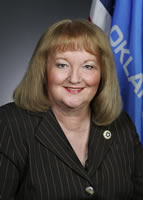
“This measure will help those working Oklahomans across the state who struggle to provide for their families instead of relying on government services,” said Sen. Debbe Leftwich, D-Oklahoma City, who chairs the committee. “I believe the people of Oklahoma would overwhelmingly vote to support this common-sense measure to reduce poverty and provide Oklahomans with fair pay for a fair days work.”
Leftwich authored Senate Joint Resolution 49, which would send to a vote of the people a proposal to raise the minimum wage in Oklahoma by 50 cents a year for five years, beginning January 1, 2007. SJR 49 provides that if the federal minimum wage is raised anytime between January 2007 and January 2011, then Oklahoma’s minimum wage would be either the amount voters approved through SJR 49 or the federal wage plus 50 cents, whichever is higher.
More than 40,000 Oklahoma workers were paid at or below the federal minimum wage in 2004, according to the U.S. Department of Labor.
The federal minimum wage was established in 1938 with the enactment of the Fair Labor Standards Act, creating a wage “floor” of 25 cents an hour. The law was intended to protect workers from exploitation and to establish a basic standard of reasonable compensation. But Congress has failed to raise the federal minimum wage since 1997, putting the nation on track to break its previous record of leaving the minimum wage stagnant for nine years during the 1980s.
Analysis from the Washington D.C.-based Economic Policy Institute (EPI) shows that inflation has eroded the value of the minimum wage until it is now worth just 33 percent of the average hourly wage of American workers, the lowest level since 1949, Leftwich noted. If the federal minimum wage had maintained its 1968 peak value, the current minimum wage would be $8.69 an hour, according to a study by the Institute on Assets and Social Policy at Brandeis University in Massachusetts.
Seventeen states and the District of Columbia have chosen to set their state minimum wage at a level higher than the federal rate of $5.15 an hour. Florida and Nevada achieved minimum wage increases by means of a vote of the people, who supported the measure by overwhelming majorities. A Pew Research Center Poll shows that nationwide, 86 percent of those polled supported raising the federal minimum wage from $5.15 to $6.45 an hour.
A study EPI conducted in 1998 failed to show any systemic, significant job losses associated with the 1996-97 minimum wage increase; in fact, following the last increase the low-wage labor market performed better than it had in decades, with lower unemployment and increased family income, Leftwich said. The average minimum wage earner brings home more than half of his or her family’s weekly earnings, according to EPI.
“Throughout the history of the minimum wage, the voters – not Congress – have taken the lead in providing working families the opportunity to attain a reasonable standard of living and contribute to the state’s economy,” said Leftwich, noting that 16 states already had minimum wage laws on the books for up to 25 years before the federal minimum wage was established. “It’s time the people of Oklahoma were given the opportunity to tell us what they need.”
SJR 49 will next be considered by the full Senate.

