In order to provide equal access and equal opportunity to people with diverse abilities, this site has been designed with accessibility in mind. Click here to view
 Oklahoma Senate
Opposing Views Heard in Eminent Domain Hearing
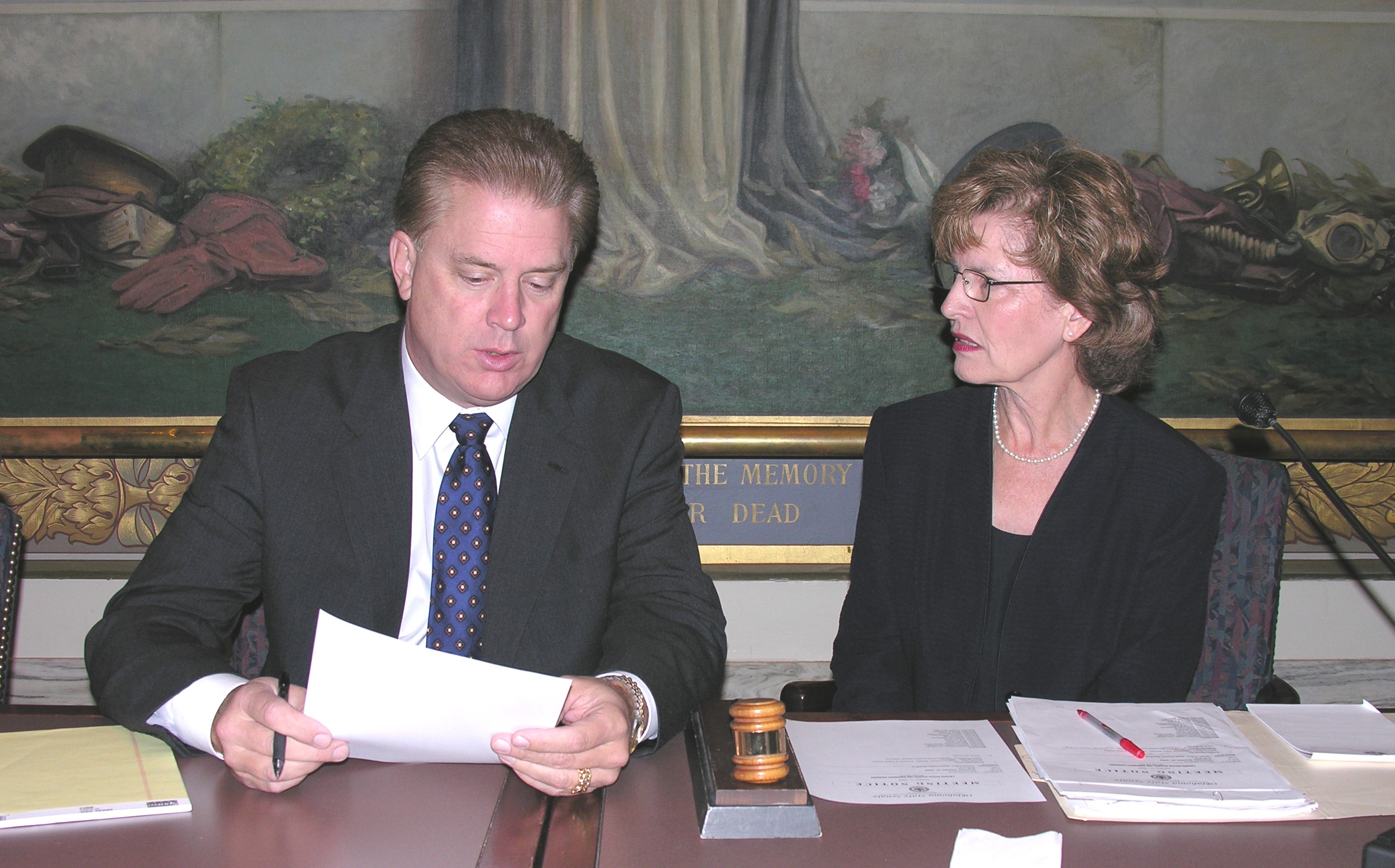 Senators Laster and Lawler preparing for second hearing on eminent domain.
State Senators Daisy Lawler and Charlie Laster said they were pleased with the second meeting held by the Senate's official legislative study on eminent domain. The two are co-chairs of the committee examining Oklahoma's current statutes on eminent domain as a result of last summer's Kelo v. City of New London Supreme Court case.
The high court ruled that a Connecticut municipality did not violate the United States Constitution when it forced property owners to sell their land for a private development project which would provide economic benefits to the community. However, the Court said that states could tighten restrictions on eminent domain.
Members of the interim study committee heard testimony from representatives of the Oklahoma Farm Bureau, the Oklahoma Municipal League, as well as an attorney representing a Midwest City business in an ongoing eminent domain case.
Sen. Lawler, who has voiced her concern for protecting the rights of private property owners while still encouraging economic development, felt that Thursday's hearing was very productive.
"I think we had a lot of good testimony today…we had a lot of different ideas," said Lawler, D-Comanche. Lawler noted that one thing discussed in committee was the fact that there are two different definitions of "blighted" in the statutes. Blight is one of the reasons property can be condemned by a municipality.
Jeremy Rich, Director of Public Policy for the Oklahoma Farm Bureau told the committee he believed there needed to be greater clarification in the statutes regarding eminent domain. Attorney Terry Shipley testified that the current statutes are antiquated and suggested a constitutional amendment on eminent domain.
However Margaret Love, an attorney with the Oklahoma Municipal League told members the current statutes and existing case law are clear.
Sen. Laster said that it was important for legislators to avoid a knee-jerk reaction to the Kelo case, but rather to proceed in a careful and deliberative manner to determine what changes may or may not be needed. While opposing views were raised during the hearing regarding eminent domain lawsuits in the state, Laster pointed out that final court rulings were still pending. He said based on what he heard in the hearing, there is no cause for alarm regarding eminent domain in Oklahoma.
"But the subject has arisen. Perhaps we need to update the laws that we have on the books in some respect. But I didn't hear anyone today criticize an actual court decision that has come down in Oklahoma as being wrong. I still think there is no cause for alarm," said Laster, D-Shawnee.
Laster and Lawler anticipate holding at least one more meeting before making any final recommendations for the 2006 session.

