 Oklahoma Senate
Senators Richard Lerblance and Jeff Rabon discuss their request for a multi-county grand jury investigation into Oklahomans for Lawsuit Reform and react to that group’s response
In order to provide equal access and equal opportunity to people with diverse abilities, this site has been designed with accessibility in mind. Click here to view
Share
back to press releases
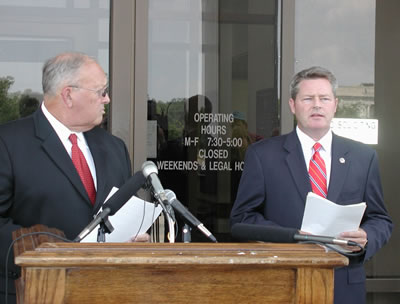 Senator Richard Lerblance (D-Hartshorne) yields to Senator Rabon (D-Hugo) during a press conference held September 2, 2004. The senators called the press conference to request a multi-county grand jury investigate the actions of the Oklahomans for Lawsu
Senators Rabon, Lerblance Call for Grand Jury Probe of Oklahomans for Lawsuit Reform
Senator Richard Lerblance (D-Hartshorne) yields to Senator Rabon (D-Hugo) during a press conference held September 2, 2004. The senators called the press conference to request a multi-county grand jury investigate the actions of the Oklahomans for Lawsu
(Oklahoma City) A pair of state senators charged Thursday that an organization claiming to be independently seeking reform of the state’s civil justice system has stepped over the line into partisan politics and its solicitation and use of secret corporate donations could be in violation of the Oklahoma Constitution and state campaign laws.
In a letter to Attorney General Drew Edmondson, Senators Jeff Rabon and Richard Lerblance asked for a multi-county grand jury investigation of Oklahomans for Lawsuit Reform, claiming that the group’s blatant solicitation of anonymous corporate donations for Republican candidates goes far beyond the legal boundaries for activities by a 501c4 corporation.
“We’ve obtained a copy of a July 29 fund-raising letter sent by OLR Chairman John Brock to doctors and corporate officers in Oklahoma. There’s no doubt that OLR is no longer operating as a 501c4 as defined in federal law but has instead become a political action committee,” said Rabon, D-Hugo. “Today, Senator Lerblance and I called on the Attorney General of our state to use the multi-county grand jury to investigate the activities of this organization.”
Lerblance said that Brock’s letter identifies OLR’s new mission as “electing a majority of Republicans in both houses” of the Oklahoma Legislature and later specifies support by the group for “Republican candidates, both local and national.”
“There’s a difference between a PAC, which can actively raise money for candidates from one party or the other, and a 501c4 organization, which is limited in its partisan activities. Mr. Brock’s recent letter clearly indicates that OLR intends to function as a PAC in raising money for and promoting Republican candidates,” said Lerblance, D-Hartshorne.
Further, the pair said, Brock’s letter tells potential donors, including corporate officials, that because OLR is designated under the Internal Revenue code as a 501c4 organization, that there are no limits to how they can contribute to its cause. Brock’s letter also says that even corporations, which are prohibited in Oklahoma from donating directly to candidates or political action committees, can make donations to OLR because of its IRS designation.
“Mr. Brock makes it clear that individuals and corporations can donate as much money as they wish to OLR and can do it anonymously and that their money will be used to fund the Republicans’ attempt to takeover the Legislature. This thing sounds more like a secret slush fund than a non-profit corporation.
“Honestly, if everything is on the up and up, why the secrecy? Why wouldn’t these people and corporations want the public to know they are donating money to this effort?” Rabon said.
In their letter to the attorney general, the Senators outlined where they believe Oklahomans for Lawsuit Reform has gone afoul of the law.
The pair believes that Oklahomans for Lawsuit Reform has violated Article 9, Section 40 of the Oklahoma Constitution and two different sections of Title 21 in Oklahoma State Statutes.
Article 9, Section 40 of the Oklahoma Constitution provides that no corporation organized or doing business in Oklahoma shall be permitted to influence elections by contributions of money or anything of value.
Title 21, Section 187.2 of Oklahoma Statutes prohibits corporations from contributing to any campaign fund of any party committee for the benefit of such party committee or its candidates.
Title 21, Section 187.1 of Oklahoma Statutes prohibits campaign contributions to be made to a particular candidate or committee through an intermediary or conduit for the purpose of evading laws relating to campaign contribution limits.
“If Oklahomans for Lawsuit reform walks like a PAC and quacks like a PAC, then it’s a PAC and it needs to obey the laws governing how a PAC can contribute to political campaigns or invest in independent expenditures that can influence elections,” Rabon said.
The recently re-elected senators said that others besides Brock and OLR co-founder Mike Cantrell could be drawn into the probe.
“Individuals who have exceeded the legal donation limit of $5,000 and officers of corporations which have donated illegally to OLR could have some questions to answer before the grand jury,” Lerblance said.
Rabon recalled how former Governor Frank Keating advocated the creation of more GOP-leaning political action committees in the 1990s as a way for individual Republicans to donate more money that would eventually find its way into the campaigns of Republican legislative candidates.
“While he was easily the most partisan governor in our state’s history, what Governor Keating advocated was governed by reasonable campaign laws. What OLR is suggesting – unlimited and anonymous contributions, including corporate contributions, for the single purpose of electing candidates from a specific political party – is, in my opinion, outside of the law and should be fully investigated immediately,” Rabon said.
He said this type of scheme isn’t new or limited to Oklahoma.
The case of Oklahomans for Lawsuit Reform seeking unreported, anonymous and corporate donations in support of Republican candidates is similar to the case under investigation by a Travis County grand jury in Austin, Texas. In that probe, a grand jury is investigating the way corporate donations to a PAC, operated by Houston Congressman Tom Delay, were used in support of Texas Republican legislative candidates.
But it’s not just Delay’s use of corporate contributions that are being scrutinized. Rabon pointed out that corporate donations to a PAC operated by Texas House Speaker Tom Craddick have also been criticized. Additionally, the Hugo senator said, the Speaker of the Ohio House of Representatives is under fire for using a non-profit issue-advocacy organization to funnel corporate donations to candidates who support him.
“It’s becoming an epidemic and we’ve got to keep it from infecting Oklahoma politics. To giant multi-million dollar corporations a $100,000 donation is pocket change, but in a state House or Senate race, that’s a lot of money. We have to say ‘no’ to this kind of abuse of campaign financing laws in Oklahoma now before it goes any further,” Rabon said.
Contact info
Senate Communications Office - (405) 521-5774

